Glories of Jagannath Dham
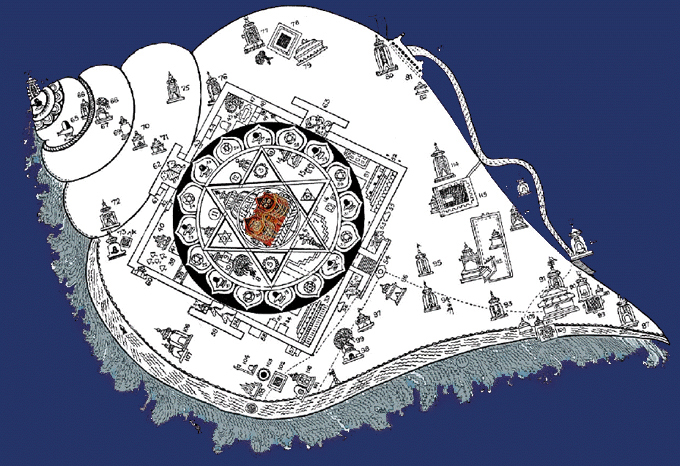
The State of Orissa is divided up into four kshetras which represent the paraphernalia of Lord Visnu: His shankha (conch), chakra (disc), gada (mace) and padma (lotus). Puri Dham, the abode of Lord Jagannath, is known as Shankha-kshetra — a manifestation of the Lord’s conch, while Bhubaneswar is Chakra-kshetra, Jajpura is Gada-kshetra, and Konark is Padma-kshetra.
Puri Shankha-kshetra is depicted as shown in the image above, laid out on a grid matching the shape of a right-handed, or Dakshinavarta-shankha. Within and along the edges of this conch are the 115 transcendental abodes of Puri Dham, being temples, shrines, mathas, tanks, trees, and other sacred sites. The area covers approximately 10 square miles, of which 40% is submerged beneath the sea.
At the center of Shankha-kshetra is the abode of Lord Jagannath, Baladeva and Subhardra, who reside in the ancient temple of Jagannath Puri, on a hillock known as Nilagiri, or the Blue Hill. To the west lies the broad end of the shankha, where Lokanath Temple is situated, one of eight Shiva temples in the Holy Dham.
The cone, or apical end of the shankha points to the east, and another Shiva temple is located there, the Nilakantha Temple. The distance between Lokanath and Nilakantha temples is about two miles.
The conch-like shape of Jagannatha Puri is also said to be comprised of seven concentric folds. The first, the innermost fold, is the kshetra’s navel, and this marks the place where the sanctum sanctorum of Lord Jagannath, brother Baladeva and sister Subhadra reside.
Lord Jagannatha’s temple has nine gates, eight being in the four directions, along two boundary walls, and one existing in the etheric realm. The enormous wall surrounding the main temple complex is known as Meghanada Pacheri. Many streets, or sahi branch out from the temple, running in all directions and leading to the other 114 tirthas, thirthams, etc. in shankha-kshetra.
Following is a list of the 115 transcendental sites located in Puri Shankha-kshetra. We will hope to uncover detailed information about each one of them in the segments to come.
- Lord Jagannatha, Baladeva, Subhadra & Sudarsan
- Khetreswari Vimala
- Mahalaxmi
- Uttar Durga
- Bata Mangala
- Garuda Stamva
- Bhoga Mandap
- Kalpabrukhya
- Rohini Kunda
- Bata Ganesh
- Uchsta Ganapati
- Sri Saraswati Devi
- Nabagraha
- Konark Suryadev
- Padapadma
- Yagnyabata
- Angeswar
- Indranidevi
- Khetrapala
- Swana Vairabi
- Mukteswari
- Chstrakali
- Batamarkandeya
- Katyayani
- Gopeewara
- Beda Kali
- Pataleswara
- Bhubaneswari
- Vaikuntheswara
- Yagnyaswari
- Isaneswar
- Sitaia Devi
- Pakasala
- Dakhineswara
- Kundaleswara
- Ram Chaitanya Temple
- Baravai Hanuman
- Nirmalya Hanuman
- Alaka Batika
- Chakra Narayan
- Rameswar
- Chaturdhama
- Kanapata Hanuman
- Niladri Vihari
- Bavabyeswara
- Sialilata
- Koili Vaikuntha
- Tapaswi Hanuman
- Survarnakupa
- Ananda Bazar
- Devasnana Mandapa
- Meghanada Prachira
- Singhadwara (East gate)
- Aruna Sthamva
- Badachhata Math
- Chhauni Math
- Pejanala
- Prahari Hanuman
- Dakhinadwar (South gate)
- Durgamadhava
- Mangaleswari
- Paschimadwar(West gate)
- Uttardwar (North gate)
- Sri Lokanath
- Rameswara
- Kandunursingha
- Kandu Asrama
- Nikumvilabata
- Harachandi
- Chamundeswari
- Banadurga
- Basheli
- Kapalmochana
- Manikarnika Teertha
- Ghatamangala
- Vagabati
- Markandeswara
- Markandeya Teertha
- Saptamatruka
- Alamba Devi
- Atharnala
- Makardhwaj Hanuman
- Vargavi River
- Mukteswara
- Bata Mangala
- Kapoteswara
- Vilweswara
- Siddha Hanuman
- Indradyumna Teertha
- Nilakantheswara
- Adinrusingha
- Gundicha Mandapa
- Mausima
- Marchika Devi
- Charchika Devi
- Sodasha Putri
- Narayani
- Angirasrama
- Angirabata
- Dakhina Kali
- Ugreswarashrama
- Swetaganga
- Muktisila
- Adisankara Pitha
- Swargadwara
- Varahi Devi
- Shyama Kali
- Bedi Hanuman
- Chakra Teertha
- Chakra Narayan
- Mahodadhi Tirtha
- Jagannatha Ballava
- Kashi Biswanatha
- Visweswari
- Narendra Sarovar